 Dexscreener
 tracks token pairs and market changes across decentralized exchanges
Dexscreener turns blockchain trading activity into searchable token pairs, price charts, and market data for decentralized exchanges. A pair represents the two assets that trade against each other in a liquidity pool. Its price, volume, and liquidity describe that market, while discovery lists, watchlists, and alerts help readers find and follow changes.
A useful reading connects each number to its token address, pool, and measurement period. Those details distinguish a changing market from a different market altogether, and they separate a displayed valuation from the amount a trade could return.
Blockchain activity becomes a pair-level market view
Dexscreener uses its own indexer to parse raw blockchain logs into market analytics. As trading activity reaches the indexer, the platform updates its market displays. On supported markets, automatic listing follows the creation of a liquidity pool and at least one transaction. This makes newly active pairs discoverable without treating their appearance as an approval decision. Automatic processing establishes that activity exists; it does not establish the token’s legitimacy, the reliability of its promoters, or the availability of a future exit. Token descriptions and social links also have a different origin from the underlying trading records.
What do the token, pair, and valuation figures represent?
The token identifies the asset, the pair identifies a particular market, and valuation figures combine price with supply. These fields answer different questions, so a large valuation cannot substitute for an assessment of liquidity.
Asset identity and market identity
Token addresses
A name or symbol can match unrelated assets. The address and chain provide a more precise identity than branding alone. An address match establishes which token a page describes; it does not establish that the token has safe permissions or credible economics. Descriptions, logos, and social profiles add context without changing that distinction.
Pair addresses
A pair address identifies the pool behind a market view. One token can appear in several pools, with different quote assets, liquidity, and trading activity. The quote asset expresses what the other asset trades against. Comparing prices across pools therefore requires attention to the price denomination and observation time. A familiar token symbol does not make two pool records interchangeable.
Liquidity and supply-based valuations
Liquidity describes assets available in a pool, while volume measures trading over a specified period. Repeated trading can produce substantial volume without leaving comparable liquidity available for an exit. Fully diluted valuation, or FDV, answers another question. Dexscreener calculates FDV by multiplying price by the difference between total supply and burned supply. Market capitalization can differ when the platform uses reported circulating supply. Neither valuation measures cash available for sellers, and a supply estimate carries its own assumptions. Missing supply information also limits what a displayed valuation can establish.
Different discovery views answer different searches
Search works best when an asset or pool is already known; discovery lists organize markets that need further investigation. The choice changes how a pair comes into view, without changing its underlying identity.
| Discovery option | Starting information | Useful result | Interpretation limit |
|---|---|---|---|
| Name or symbol search | Token branding | Candidate token matches | Names and symbols can repeat |
| Address search | Token or pair address | Matches for the specified identifier | The chain and address type must match |
| New Pairs | Recently created markets | New pool activity | A new pool does not prove a new token |
| Gainers & Losers | Price movement over a selected period | Markets with directional changes | A different period changes the comparison |
| Trending | The platform’s ranking inputs | Pairs attracting activity and attention | Paid Boosts can influence placement |
| Discovery identifies markets to examine; the chain, token address, and pair address establish which market each result describes. | |||
Pair age refers to the pool, so it cannot establish the token’s full history. Likewise, a large percentage move describes a particular interval. Short histories and limited liquidity can make prominent changes difficult to interpret, especially when a list supplies little context beyond the headline movement.
Does a trending position indicate token quality?
A trending position indicates the platform’s ranking of activity and attention, not a reliable assessment of token quality. The ranking considers market activity, community engagement, token information, and security-related signals. Its inputs include volume, liquidity, transactions, makers, holders, page visits, and reactions. The platform does not publish the complete weighting formula, so an outside reader cannot reconstruct the ranking from one visible metric.
Paid Boosts temporarily multiply a token’s existing Trending Score. They influence visibility without guaranteeing a leading position. A Boost badge therefore has a promotional meaning, separate from evidence about ownership or sellability. Boost purchases are non-refundable, and moderation can remove Boosts from tokens flagged as malicious. Paid exposure should be distinguished from organic trading interest.
Following a market without committing funds
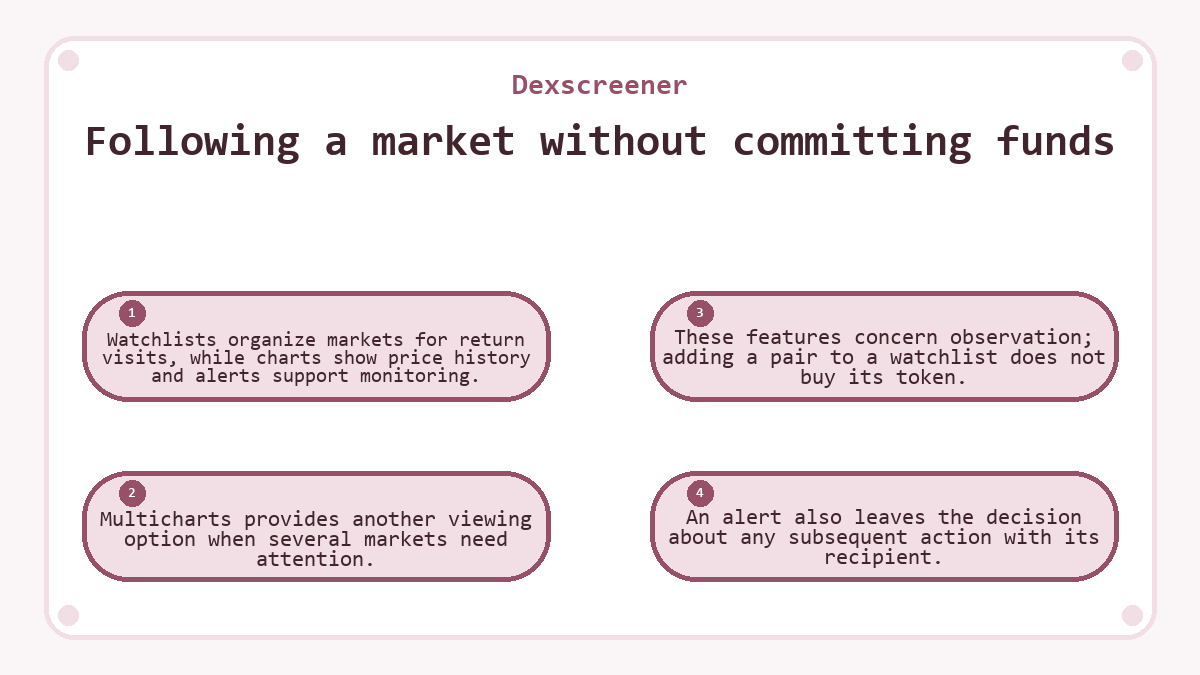
Watchlists organize markets for return visits, while charts show price history and alerts support monitoring. Multicharts provides another viewing option when several markets need attention. These features concern observation; adding a pair to a watchlist does not buy its token. An alert also leaves the decision about any subsequent action with its recipient.
Comparable observations require a stable reference: the same chain, token, pair, denomination, and time window. Price and liquidity remain live values even when those identifiers stay fixed. A saved screenshot preserves an earlier display, rather than a price that remains available. Later observations can reveal market changes, but only when their scope matches the earlier record. Switching pools or measurement periods introduces a different explanation for an apparent jump.
A swap introduces a separate commitment. The quoted output, applicable fees, available liquidity, and transaction protections govern execution. Reading a chart or abandoning an unsigned transaction leaves holdings unchanged. Once a swap settles, closing the analytics page does not reverse it. Selling afterward requires another transaction under the conditions available then.
Why can the chart and swap result disagree?
The chart reflects observed market prices, while a swap result depends on trade size, execution conditions, and timing. In an automated market maker, a trade changes the pool’s pricing as it consumes available liquidity. This price impact varies with the amount traded and liquidity available at relevant prices. Other activity before execution can change the outcome further. A displayed liquidity total alone cannot establish the output for a specific sale, and a chart price is not an executable quote.
A discrepancy can also come from different pools, quote assets, fees, or observation times. The transaction record and actual token balance change establish what a completed swap delivered; the analytics display supplies market context. If the transaction remains pending or failed, a chart update does not establish completion. Repeating a submission before resolving its status can create another commitment. For an eventual exit, the available liquidity and token restrictions at that time determine whether a sale can execute. Earlier volume, a higher historical price, and a prominent ranking do not reserve an exit price.
Still wondering about Dexscreener?
-
Is Dexscreener available as a mobile app?
- Dexscreener has apps for iOS and Android. Mobile availability does not mean every browser feature also appears in the app. Boost purchasing, for example, operates through the web browser rather than the mobile app.
-
Does Dexscreener have its own token?
- Dexscreener does not have its own token. A token or presale using its name does not establish a connection to the platform. Automatic discovery can display unrelated tokens with familiar branding, so a searchable listing is not evidence that the platform issued the asset. The same distinction applies to logos and promotional descriptions.
-
What can developers retrieve through the API?
- The API provides structured data for supported pairs, token searches, profiles, and promotional activity. Pair records include identifiers and market fields such as price, volume, liquidity, and transaction counts. Availability varies by field, and some values can be null. A null market capitalization means the response lacks that value; treating it as zero would change its meaning. Request limits also vary by endpoint.
-
How does a token’s description or social information appear?
- Token information can come from external token lists or the Enhanced Token Info service. Descriptive information follows a separate process from the indexing of pool transactions. A missing logo or description therefore does not, by itself, mean trading records are absent. Conversely, a detailed profile does not establish the accuracy of promotional claims or the safety of the token.
-
Can browsing Dexscreener reveal information about my activity?
- Browsing can generate usage data even without a token transaction. The service’s privacy policy describes collection of information such as IP addresses, device details, visited pages, and interactions, alongside cookies and similar tracking technologies. Account information adds another category when supplied. Public blockchain data and website browsing data are separate, so viewing an address does not make the browsing session anonymous.