 Dexscreener
 identifies pool market data by chain and pair address
Dexscreener lets you match a market observation to a specific pool using its chain and pair address. Before comparing price changes, retain those identifiers alongside the token addresses, displayed units, selected period, and observation time. Later readings belong in the same comparison only when the market identity matches. A familiar ticker or similar price does not establish that match, and switching pools changes what the comparison describes.
A different pool changes the meaning of a price comparison
Comparing observations from different pools mixes changes over time with differences between markets, so an apparent price movement may reflect a changed selection. The same token can participate in several pools. Each pool has its own trading activity and liquidity conditions, which makes the selected market part of the observation.
A ticker helps a person recognize a token, but it does not uniquely identify the market under inspection. Treat a matching name as a search aid. For a repeatable comparison, retain the complete identifiers rather than relying on a recognizable logo, abbreviated address, or remembered position in a results list.
Connect the chain, token addresses, and pair address
The chain establishes the network context, token addresses identify the assets, and the pair address distinguishes the selected market within that context.
Chain and token identity
Record the network together with each token address. An address without its chain leaves the record incomplete, especially when comparing information across multiple networks. Keep the full strings intact rather than rewriting them from a shortened display.
Base and quote labels also belong in the record. They explain which asset occupies each side of the displayed pair. A comparison that silently reverses those roles can change the meaning of the quoted price even when the asset names look familiar.
Pair and exchange identity
The pair lookup accepts both a chain identifier and a pair identifier. Its returned data distinguishes the exchange, pair address, and base and quote token addresses.
Keep the exchange label as supporting context alongside the address. It helps explain why two results involving the same assets represent separate markets. The chain and full pair address should remain the identifiers that connect successive observations.
Separate the market identity from its changing measurements
A useful starting record separates the identifiers that define the selected pool from the measurements that describe its condition at a particular time. Put the chain, pair address, token addresses, and exchange together. Beside them, record the observation time and the values that matter to the comparison.
Retain the displayed price denomination and any period attached to volume or price change. Include liquidity when it helps explain the market condition, keeping its unit visible. Avoid copying a number alone: a detached value loses the context needed to interpret it later.
Mark your timestamp as the time you recorded the display. That timestamp does not establish the exact time of the underlying trade or the freshness of every field. This distinction matters when two readings occur close together and the values disagree.
Keep the measurement period consistent
Matching the pool does not make differently timed measurements equivalent; a rolling activity window and a change between saved observations describe different intervals. Record the selected window beside each reading. A chart interval describes another aspect of presentation, so keep it separate from the period attached to a summary statistic. Alerts can draw attention to a change, but the comparison still needs its own identifiable pool and measurement period.
Leave missing measurements visibly unresolved
An absent value should remain absent in the comparison because replacing it with zero creates a numerical claim that the observation does not support. Pair data can contain unavailable fields, including liquidity or dollar-denominated price. Mark the affected measurement as missing while retaining the identifiers that you did capture.
A gap also limits interpretation. Without comparable readings, the record cannot establish the size of a change for that field. Filling the gap with a value from another pool would answer a different question, even if both pools contain the same token.
What should I do if the reopened pair address differs?
Keep the earlier observation intact and separate the new pool from the existing series until you resolve the address mismatch. The available action depends on whether you can recover the original market with matching identifiers.
- If the chain and full pair address match, compare the token identities, units, and periods before appending the new reading.
- If either identifier differs, hold the new reading outside the existing comparison while checking the saved address.
- If the original pool remains available, return to that pool and record its values with a fresh observation time.
- If you intentionally choose the different pool, start a separate record and preserve the earlier series.
- After saving either record, compare its identifiers with the open market again so that a navigation change does not enter unnoticed.
Continuing with the original pool preserves a comparison over time. Starting a separate record permits comparison between markets, but it cannot extend the original pool’s history. Both actions retain the same identity and measurement fields; changing the pool determines which conclusion the record can support.
Before saving, you can change the selection without altering the earlier record. After saving, retain a correction note for a mistaken entry rather than silently replacing its identifiers. That preserves an explanation for any discontinuity.
Read price and activity changes on their own terms
Once identity matches, interpret each changed measurement according to its unit and time basis rather than treating every difference as evidence of the same event.
Price denomination
A token-denominated price and a dollar-denominated price use different units. Keep the denomination attached to the value throughout the record. The comparison should state whether it concerns the token’s value against the quoted asset or its dollar value.
Changing the denomination changes the question. A movement against the quoted asset need not match the movement in dollars, because the quoted asset’s own dollar value may also change. This is a unit distinction, not an address mismatch.
Activity and liquidity
Volume measures trading activity over a period, while liquidity describes the pool’s available assets at an observation point. Keep them in separate fields. Subtracting rolling volume readings does not necessarily reveal the volume traded between your observation times.
Likewise, a change in liquidity’s dollar value does not by itself establish that someone deposited or withdrew assets. Valuation changes can affect that number. Identical pool addresses establish continuity of the market, not the cause of every movement within it.
Distinguish similar pools without merging their histories
Two pools containing the same token can differ in their quoted asset, exchange, and liquidity, so the comparison needs to preserve those distinctions. When the quote assets differ, the prices may use different denominators. When the assets match but the pool addresses differ, trading conditions still belong to separate markets.
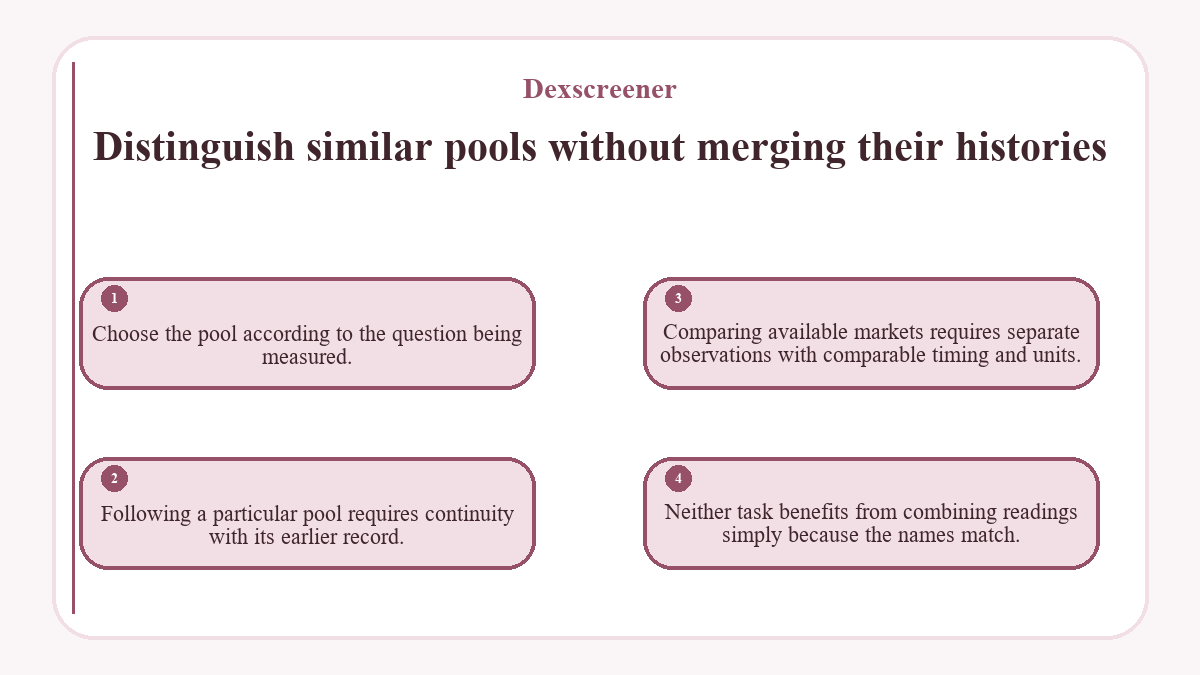
Choose the pool according to the question being measured. Following a particular pool requires continuity with its earlier record. Comparing available markets requires separate observations with comparable timing and units. Neither task benefits from combining readings simply because the names match.
Preserve the point where the comparison changes
A usable history makes changes of pool, denomination, and measurement period visible instead of presenting every saved number as one uninterrupted series. Keep those changes beside the affected observation, with enough detail to explain the break. The next review can then distinguish a market movement from a changed selection without reconstructing the earlier session.
Dexscreener - your questions answered
Does a matching pair address prove that the token is trustworthy?
Matching the chain and full pair address establishes which market you are examining, not whether the token deserves trust. It supports continuity between observations of that pool. It does not establish the token’s ownership, contract permissions, or the reliability of claims about it. Keep the conclusion limited to market identity rather than treating a successful address match as an assessment of the asset.
Can a cropped screenshot support a later pool comparison?
A cropped screenshot supports only the details that remain visible or survive in an accompanying record. A price image without the chain, full pair address, denomination, and observation time cannot establish a complete match by itself. Keep those details in text alongside the image, particularly when the interface abbreviates addresses or the crop removes the selected measurement period.
Why might two displays of the same pool show slightly different rounded prices?
Different display precision can produce different-looking prices from the same underlying value. Compare the available decimal places and observation times before interpreting a small discrepancy as a market change. Rounding explains only differences consistent with that precision; it does not explain an arbitrary gap. Preserve the value as displayed rather than adding decimal places that the record never contained.
Should I overwrite an earlier observation after discovering an address error?
Preserve the original entry and attach a correction that identifies the mistaken market. Silent replacement makes later calculations difficult to trace, especially if another comparison already used the entry. Exclude the incorrect reading from the intended pool’s series, while retaining enough context to explain the correction. A corrected identifier cannot establish what the intended pool’s price was at the earlier time.
Is matching only the beginning and end of a pair address sufficient?
Matching an address’s beginning and end does not establish that the complete strings are identical. Abbreviated displays omit the middle characters, which remain part of the identifier. Use the full address for the comparison and preserve its original spelling. A visual abbreviation can help locate a record, but it cannot supply the omitted characters needed for an exact match.